Kankalitala Temple in West Bengal
Kankalitala is a temple town in Bolpur subdivision of Birbhum district in the Indian state of West Bengal.The mythology of Daksha yaga and Sati’s self immolation is the story of origin behind Shakti Peethas. Shakti Peethas are holy abode of Devi formed due to the falling of body parts of the corpse of Sati Devi, when Shiva carried it and wandered through. There are 51 Shakti Peeth linking to the 51 alphabets in Sanskrit. Each temple has shrines for Shakti and Kalabhairava. The Shakti of the temple is addressed as “Devgarbha” and the Bhairava as “Ruru”. It is believed that Sati Devi’s bones have fallen here.
Legend of Kankalitala Temple
However in the center there are no permanent structures except the main temple and the water tank – the associated Shiva temple is a couple of hundred meters away, close to the entrance to the temple complex.
The Shivalingam is made of hard black stone & worshipped by the name of Shambhu aka Ruru Bhairav.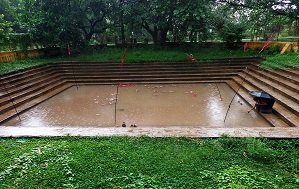 The Lingam appears to be buried – it is situated in a pit with the chamber’s marble interiors surrounding it on all sidesThe lingam was once complete & protruding from the ground like normal Shivalingams.It was broken base upwards by a Muslim soldier named Kalapathar (literally “Black stone”, perhaps referring to his physical strength or his stone-heartedness) when Bengal was ruled by the Pathan warlord Sulaiman Khan Karrani.(That such a thick monolith was broken to pieces speaks of the animosity Kalapathar felt for Hindus & their traditions, though it is said that he himself was a convert from Hinduism who later specialized in destroying temples & religious sites.)Not far from the mandir’s front gate, a narrow dirt road leads away from the temple and toward Kankalitala’s cremation ground.Walking along this footpath, one will see numerous samadhis on its opposite sides. These are the grave markers of tantriks and sadhus.Entering the main area of the cremation ground brings you to the place where human bodies are burned.The system for performing this activity here is different from what I have observed previously at such burning grounds as Tarapith and Manikarnika.Instead of the typical temporary construction of a wood pyre which is then set alight, at Kankalitala there are two semi-permanent structures which are utilized.Each is essentially a raised, open platform made from several pieces of metal girder spanning across and secured in place by two short walls. These walls are made of bricks that have been covered over with mud which, now dry, feels solid like fired clay.
Categories: Shakti Peeth


